
Granular and powder products look simple to pack.
But anyone who has worked on a real production floor knows that these products can be some of the most challenging to handle.
Sugar flows very fast. Salt absorbs moisture. Detergent creates dust. Pulses roll differently based on size and polish. Fertilizer granules may be abrasive. Ready-mix powder can bridge inside the hopper. Fine powders may not flow at all unless the feeding system is designed properly.
This is why selecting a weighing machine only by looking at speed, price, or machine size is never enough.
The right machine depends on the product.
At SmartFill, we work with Multihead Weighers, Linear Weighers, Cut-Gate Weighers, and Bulk Weighers for different food, agro, chemical, and non-food applications. For granular and powder products, the machine selection must be done carefully because the same product category can behave differently from one factory to another.
This guide explains how to choose the right weighing system for granular and powder products, especially for Indian packaging conditions.
What Are Granular and Powder Products?
Granular products are materials made of small particles or pieces. They generally flow better than powders, but their behaviour depends on size, shape, density, moisture, and surface texture.
Common granular products include:
- Sugar
- Salt
- Pulses
- Rice
- Seeds
- Grains
- Fertilizer granules
- Detergent granules
- Plastic granules
- Sulphur
- Tea
- Coffee beans
- Small hardware items
Powder products are finer materials. They may flow smoothly, slowly, or not at all depending on the product.
Common powder products include:
- Detergent powder
- Ready-mix powder
- Spice powder
- Flour-based mixes
- Chemical powders
- Supplement powder
- Fertilizer powder
- Food premixes
- Masala blends
- Fine salt
- Powdered additives
Both granular and powder products need weighing accuracy, but they create different challenges inside the machine.
Why Granular and Powder Products Are Difficult to Weigh
A weighing machine does not only measure weight.
It also has to control how the product moves.
For granular and powder products, this movement can be unpredictable.
Some products flow too fast. Some flow too slowly. Some stick to the surface. Some create dust. Some settle unevenly. Some products change behaviour when humidity increases. Some products behave well during trial but create issues after continuous production.
That is why the feeding system, hopper design, vibration control, load cell response, discharge path, surface finish, and machine tuning all matter.
A good weighing machine should not just weigh the product. It should understand the product.
Challenge 1: Free-Flowing Products
Free-flowing products move quickly through the feeding system.
Examples include:
- Sugar
- Salt
- Rice
- Pulses
- Seeds
- Plastic granules
- Sulphur
- Fertilizer granules
These products may look easy to handle, but they create one major challenge: overshooting the target weight.
When product flows very fast, even a small delay in gate closing or feeder stopping can add extra weight. This extra weight becomes giveaway.
For example, if the target weight is 1 kg and the machine repeatedly fills 1.012 kg or 1.018 kg, the customer loses product in every pouch or bag. Over one shift, this becomes a cost. Over one year, it becomes a serious loss.
For such products, the weighing system must have fast response, stable load cell reading, controlled feeding, and intelligent correction.
SmartFill Recommendation for Free-Flowing Granules
For free-flowing granular products, SmartFill generally recommends the Nexus Cut-Gate Weigher or a suitable Multihead Weigher, depending on the pack size, speed requirement, and accuracy expectation.
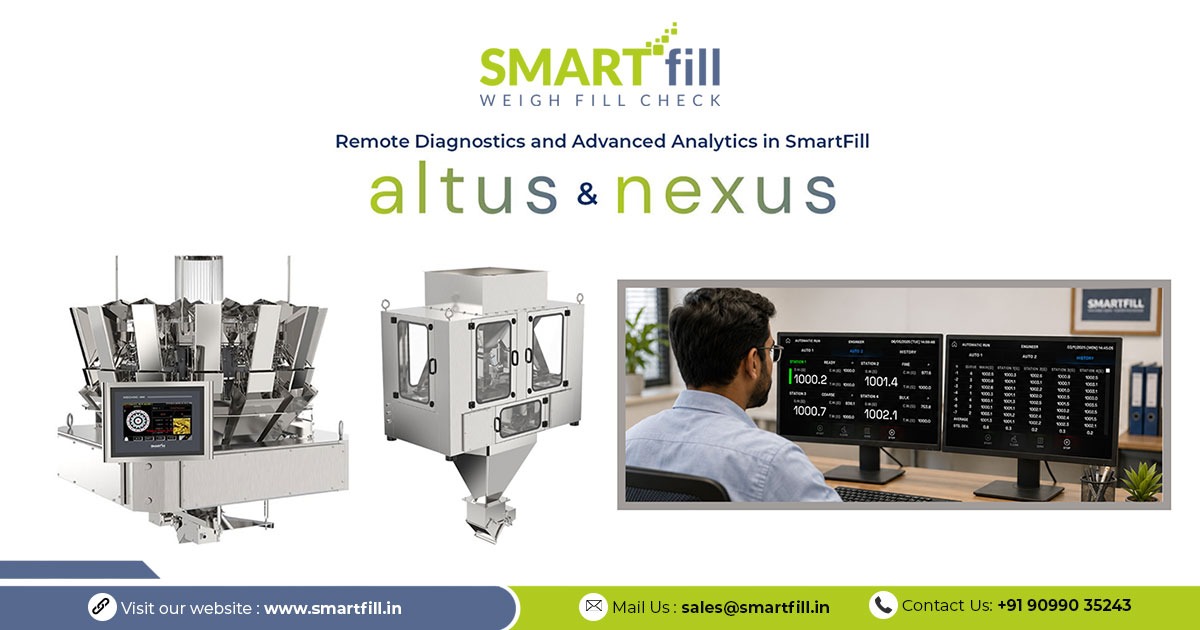
SmartFill Nexus Cut-Gate Weigher
Nexus is available in:
- 4H3L
- 4H10L
- 4H15L
It uses two feeding mechanisms:
- Gravity feeder for coarse feeding
- Electromagnetic vibratory feeder for fine feeding
The gravity feeder fills most of the target weight quickly. The electromagnetic vibratory feeder then handles the final correction.
This makes Nexus suitable for free-flowing products where speed and robustness are important.
One of the important engineering features in Nexus is weight-in-air correction. In fast-flowing products, some material may already leave the gravity feeder but may not have reached the weighing bucket yet. This material is “in the air”. The machine has to consider this falling material before closing the gate, otherwise the final weight may overshoot.
SmartFill Nexus uses correction logic to account for this product-in-motion and reduce giveaway.
This is especially useful for products like sugar, salt, pulses, sulphur, detergent granules, seeds, and plastic granules.
Challenge 2: Dusty Products
Dust is a major issue in Indian packaging plants.
Many products create fine dust during feeding, vibration, weighing, and discharge.
Examples include:
- Detergent powder
- Spice blends
- Ready-mix powders
- Fertilizer powder
- Chemical powders
- Fine salt
- Premixes
- Food additives
Dust can create multiple problems:
- It affects machine cleanliness
- It settles on sensors and machine parts
- It makes the working area uncomfortable
- It can affect weighing stability
- It increases cleaning time
- It may require better sealing and dust management
For such products, the machine cannot be selected only based on speed. Dust control, feeding behaviour, and maintenance access become equally important.
SmartFill Recommendation for Dusty Products
For dusty products, the right solution depends heavily on the nature of the powder.
Some powders can be handled on a Linear Weigher. Some may require a customized Multihead Weigher. Some may need a different filling system altogether if the powder is very fine or non-free-flowing.
At SmartFill, we first evaluate:
- Is the powder free-flowing or non-free-flowing?
- Does it create dust during vibration?
- Does it bridge inside the hopper?
- Does it stick to contact parts?
- What is the target weight?
- What is the required speed?
- Is the line semi-automatic or fully automatic?
- Is dust extraction required?
- Does the packing machine need synchronized discharge?
For many moderate-speed applications, a Linear Weigher can be a practical solution. For higher-speed retail pouch packing, a customized Multihead Weigher can be considered depending on the product behaviour.
For very difficult powder products, application trials are strongly recommended before finalizing the machine.
Challenge 3: Sticky, Moist, or Poor-Flow Products
Some products do not flow freely. They stick, bridge, cling, or move unevenly.
Examples include:
- Moist detergent powder
- Coated granules
- Masala-coated products
- Sticky snack products
- Certain ready-mix powders
- Hygroscopic salts
- Fine chemical powders
- Products affected by humidity
In such products, the main challenge is not only weighing accuracy. The bigger challenge is controlled movement.
If the product does not reach the weighing bucket consistently, the machine cannot maintain speed or accuracy.
This is where feed pan design, vibration tuning, hopper angle, surface finish, and product-contact material become important.
SmartFill Approach for Difficult-Flow Products
For difficult-flow products, SmartFill studies the product before recommending a machine.
Depending on the application, possible solutions may include:
- Customized tray design
- Different hopper angle
- Modified discharge path
- Teflon-coated contact parts
- Dimpled surface finish
- Electropolished contact parts
- Special vibration tuning
- Wider product flow area
- Reduced product travel restriction
- Product-specific machine settings
The goal is simple: the product should move consistently without sticking, bridging, or sudden dumping.
A standard machine may work for many products, but sticky and poor-flow products often need product-specific engineering.
This is where local application understanding becomes very important.
Challenge 4: Product Density Variation
Granular and powder products often vary in bulk density.
The same 1 kg weight may occupy different volumes depending on the product.
For example:
- 1 kg of sugar takes one type of volume
- 1 kg of puffed material takes much more volume
- 1 kg of detergent may behave differently depending on particle size
- 1 kg of fertilizer granules may be dense and fast-flowing
This directly affects hopper size, feeder selection, bucket volume, discharge timing, and speed.
If the hopper is too small, the product will not fit properly. If the bucket is too large, accuracy may suffer in smaller target weights. If the feeder is too aggressive, the product may overshoot. If the feeder is too slow, production speed drops.
That is why product density must be checked before machine selection.
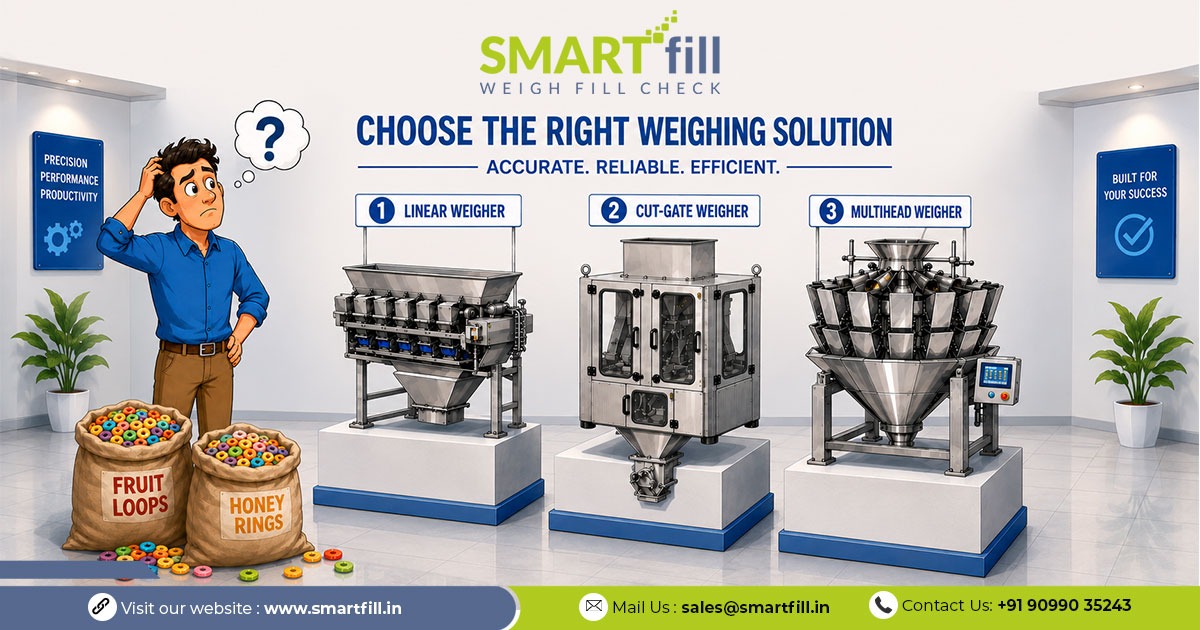
How to Choose Between Multihead, Linear, Cut-Gate, and Bulk Weigher
There is no single machine that fits every granular or powder product.
The right machine depends on the product and packaging requirement.
1. Multihead Weigher
A Multihead Weigher is suitable when speed and accuracy are important.
It uses multiple weighing heads to calculate the best possible weight combination before discharge. This makes it very useful for retail packaging where giveaway control matters.
Suitable for:
- Snacks
- Pulses
- Seeds
- Dry fruits
- Granular food products
- Frozen products
- Pet food
- Small plastic components
- Hardware items
- Certain granular powders, depending on flow
When to choose a Multihead Weigher:
- You need higher speed
- You need better accuracy
- You want lower giveaway
- Product can be distributed across multiple heads
- You are integrating with FFS or VFFS machines
- Pack sizes are small to medium
- Product behaviour is suitable for vibration feeding
SmartFill Multihead Weigher Range
SmartFill offers the Essentia+ Multihead Weigher in 10H and 14H variants.
The 10-head variant is suitable for moderate-speed applications, while the 14-head variant is preferred where higher speed and better combination accuracy are needed.
For advanced applications, SmartFill also offers the Altus Multihead Weigher, designed for higher performance, better diagnostics, and improved application-level control.
2. Linear Weigher
A Linear Weigher is a simple and practical weighing solution for moderate-speed and semi-automatic applications.
It is usually preferred where the customer wants to reduce manual weighing but does not need a full high-speed Multihead Weigher line.
Suitable for:
- Pulses
- Rice
- Seeds
- Grains
- Tea
- Sugar
- Detergent powder
- Fertilizer granules
- Dry powders
- General granular products
When to choose a Linear Weigher:
- Speed requirement is moderate
- Budget is controlled
- Packing is semi-automatic
- Operator will hold or place the bag manually
- Product flow is predictable
- Target weight is higher than small retail packs
- Setup needs to be simple and easy to maintain
Typical setup:
Linear Weigher + Conveyor + Stitching Machine
This works well for many Indian factories that are moving from manual packing to semi-automatic packing.
3. Cut-Gate Weigher
A Cut-Gate Weigher is suitable for free-flowing products where fast coarse feeding and controlled final correction are needed.
It is more rugged and practical for many agro, chemical, industrial, and granular applications.
Suitable for:
- Sugar
- Salt
- Pulses
- Grains
- Seeds
- Sulphur
- Detergent granules
- Fertilizer granules
- Plastic granules
- Hardware components
When to choose a Cut-Gate Weigher:
- Product flows freely
- Target weight is moderate to high
- Robustness is important
- Speed and accuracy both matter
- Product does not require multihead combination logic
- Application is agro, chemical, hardware, or industrial
SmartFill Nexus Range
SmartFill Nexus Cut-Gate Weigher is available in:
- 4H3L
- 4H10L
- 4H15L
The correct variant depends on product volume, target weight, speed, and bulk density.
4. Bulk Weigher
A Bulk Weigher is used for larger bagging applications.
It is suitable when the customer is packing bigger quantities in bags or sacks.
Suitable for:
- Rice
- Wheat
- Pulses
- Seeds
- Fertilizers
- Animal feed
- Chemicals
- Detergent
- Plastic granules
- Industrial raw materials
When to choose a Bulk Weigher:
- Pack size is large
- Bagging is required
- Speed requirement is moderate
- Setup needs to be rugged
- Customer wants to reduce manual weighing
- Conveyor and stitching machine integration is needed
Typical setup:
Bulk Weigher + Conveyor + Stitching Machine
This is commonly useful for agro, fertilizer, feed, and industrial packaging units.
Manual Setup vs Automatic Setup
For granular and powder products, the packaging setup also decides the right machine.
Semi-Automatic Setup
A semi-automatic setup is useful when production volume is moderate or when the customer wants a practical first step into automation.
Typical setup:
Weigher + Conveyor + Stitching Machine
This setup is suitable for:
- Seeds
- Fertilizers
- Pulses
- Grains
- Detergent
- Animal feed
- Plastic granules
- Industrial products
It reduces manual weighing effort while keeping the system simple and easy to operate.
Fully Automatic Setup
A fully automatic setup is used when the customer needs speed, consistency, and lower manpower dependency.
Typical setup:
Weigher + FFS / VFFS Machine
This setup is suitable for:
- Retail pouches
- Snacks
- Pulses
- Grains
- Seeds
- Detergent
- Powder products
- Frozen products
- Small components
SmartFill machines can integrate with Indian-made FFS, VFFS, pouch packing, and custom packaging machines.
Why Indian Factory Conditions Matter
Machines do not work inside brochures. They work inside factories.
Indian factories have their own realities.
- Dust is common
- Humidity changes product behaviour
- Operators need simple cleaning access
- Spare parts must be available quickly
- Service response needs to be fast
- Power and air conditions may vary
- Products may not be uniform across batches
- Customers often run multiple SKUs on the same line
- Packaging machine integration needs practical coordination
This is why local engineering support matters.
An imported machine may perform well in ideal conditions, but Indian factories need a supplier who can support product trials, application tuning, service, spare parts, and real-time problem solving.
SmartFill’s advantage is not only that the machines are Made in India. The larger advantage is that the machines are built and supported around Indian production realities.
What SmartFill Checks Before Recommending a Machine
Before suggesting a weighing system, SmartFill looks at the actual application.
Important questions include:
- What is the product?
- Is it granular or powder?
- Is it free-flowing or sticky?
- Does it create dust?
- Does it absorb moisture?
- What is the target weight?
- What is the expected speed?
- What is the acceptable accuracy?
- What is the bulk density?
- Is the setup manual, semi-automatic, or automatic?
- Will the machine connect with FFS or VFFS?
- How many SKUs will run on the same machine?
- What cleaning frequency is expected?
- What is the production environment like?
This helps avoid wrong machine selection.
A machine that is perfect for sugar may not be right for ready-mix powder. A machine suitable for pulses may not be suitable for sticky detergent. A Multihead Weigher may be perfect for small retail packs, while a Linear Weigher may be better for slower semi-automatic bagging.
Why Product Trials Are Important
Product trials are the most honest way to choose a weighing machine.
A sample product can tell us what a brochure cannot.
During trials, we can check:
- Feeding behaviour
- Product flow
- Dust generation
- Accuracy
- Speed
- Giveaway
- Discharge pattern
- Hopper suitability
- Vibration response
- Cleaning requirement
- Integration possibility
This is why SmartFill encourages customers and OEMs to bring their product samples to our factory.
Bring your material. We will keep the machine ready.
This helps both sides make a better decision before investing in the machine.
SmartFill’s Answer to Granular and Powder Weighing
SmartFill offers a complete range of weighing systems for granular and powder applications:
- Multihead Weighers
- Linear Weighers
- Cut-Gate Weighers
- Bulk Weighers
- Customized weighing systems
Our machines are used across food, agro, chemical, hardware, and industrial applications.
Common applications include:
- Sugar
- Salt
- Pulses
- Rice
- Seeds
- Grains
- Detergent
- Fertilizers
- Sulphur
- Plastic granules
- Ready-mix powders
- Spice blends
- Dry snacks
- Pet food
- Hardware components
For each product, the machine has to be selected based on product behaviour and packaging requirement.
That is the SmartFill approach.
Not one machine for everything.
The right machine for the right product.
Final Thought
Granular and powder weighing is not only a technical subject. It is a production-floor subject.
The real question is not:
“Which machine is fastest?”
The better question is:
“Which machine can handle my product consistently, accurately, and reliably in my factory conditions?”
For some products, the answer may be a Multihead Weigher. For some, it may be a Linear Weigher. For free-flowing granules, it may be a Nexus Cut-Gate Weigher. For large bags, it may be a Bulk Weigher.
At SmartFill, we help customers choose the machine based on product behaviour, not assumptions.
If you are packing granular or powder products and are unsure which weighing system fits your requirement, visit our factory with your material.
We will test it with you.
We will show you the result.
And we will help you choose the right weighing solution.
Contact SmartFill Solutions for product trials and machine selection support.
Call: +91 90990 35243
Website: www.smartfill.in