Over the past decade, India’s packaging automation industry has grown rapidly. As more food, chemical, and industrial manufacturers move toward automated weighing and packaging systems, the demand for cost-effective machines has increased significantly.
One visible trend in this transition is the presence of Chinese-origin weighing systems in the Indian market.
These machines are attractive to many buyers because they are competitively priced and readily available. With faster shipping cycles and aggressive distributor networks, they have managed to capture a noticeable share of the entry-level and mid-range packaging automation segment.
However, the way many of these machines enter the market is often less visible to the end buyer.
The Role of White Labeling
A common practice used in this market is white labeling.
In this model, importers purchase machines in bulk from overseas manufacturers and rebrand them under their own company name. The machine body may carry a different logo, and in some cases even the HMI interface, startup screen, and control software branding are customized to display the importer’s identity.
Because of this, the machine may appear to be locally manufactured even though its design, electronics, and production originate overseas.
These rebranded machines are frequently showcased in industry exhibitions and trade fairs, where they are presented confidently as part of the exhibitor’s product lineup. For many buyers who are new to automation, it becomes difficult to differentiate between a true manufacturer and an import-based distributor model.
This is not necessarily wrong as a business model, but it makes transparency important for buyers to evaluate long-term partnerships.
A Simple Buying Guide: How to Identify the Difference
For companies investing in weighing automation, understanding the origin of the equipment helps set the right expectations for service, customization, and long-term support.
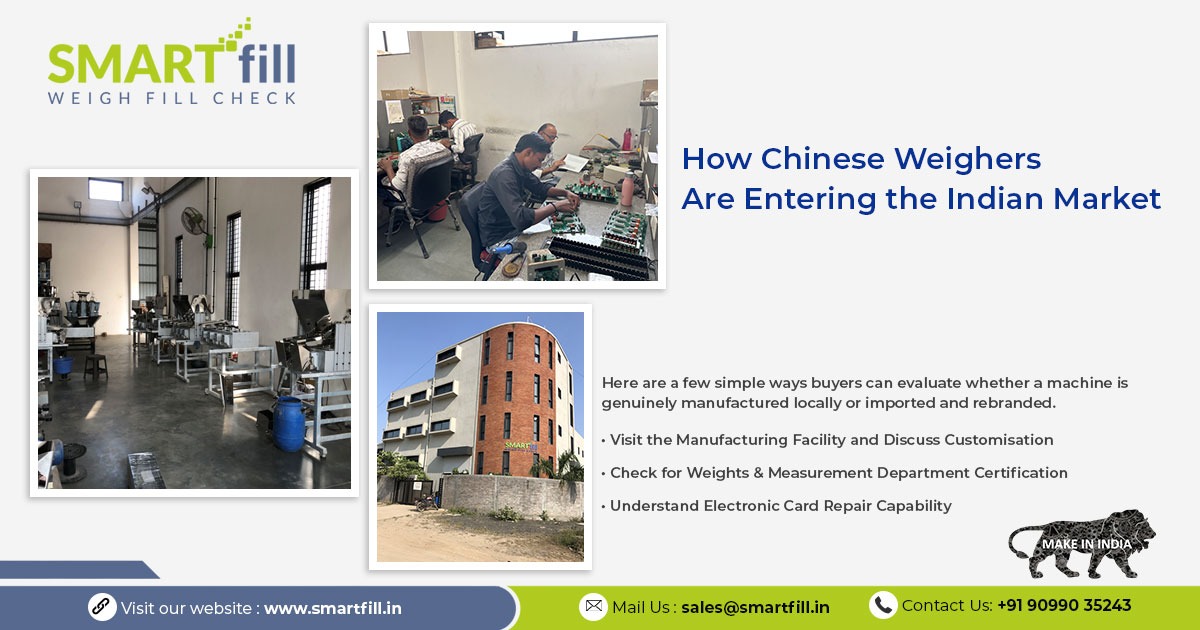
Here are a few simple ways buyers can evaluate whether a machine is genuinely manufactured locally or imported and rebranded.
a. Visit the Manufacturing Facility and Discuss Customisation
A genuine manufacturer will usually have a fully functional production facility where designing, fabrication, assembly, testing, and quality checks take place.
If possible, visit the factory and observe how different departments operate – mechanical fabrication, electronics assembly, software development, and final machine testing. This gives a clear sense of the engineering depth behind the product.
Another good indicator is how the company responds to customization requests. Manufacturers who design their machines in-house are typically open to modifying bucket sizes, feeding systems, or control logic to suit specific applications. Import-based suppliers usually have limited flexibility because the core machine design is fixed.
A factory visit often reveals far more about a company’s manufacturing capability than any brochure.
b. Check for Weights & Measurement Department Certification
In India, weighing equipment must comply with Legal Metrology / Weights & Measurement Department regulations for accurate and certified weighing.
Machines designed and manufactured locally are usually tested and certified under Indian regulatory standards. This ensures that the system meets required accuracy levels and can be deployed confidently in regulated industries.
Asking for these certifications can provide useful clarity about the machine’s compliance and legitimacy in the local market.
c. Understand Electronic Card Repair Capability
Most machines contain electronic control cards that manage load cells, filtering algorithms, and machine logic.
When a failure occurs, some suppliers may recommend complete card replacement, which can be expensive. In many cases, replacing a card may cost ₹10,000 or more, even when the issue could be repaired.
Manufacturers who design and build their own electronics often have the ability to repair these cards in-house. For example, minor repairs may cost ₹2,000 instead of replacing the entire card.
Over the lifetime of a machine, this difference significantly impacts the Total Cost of Ownership. While the initial acquisition cost may appear similar across suppliers, long-term maintenance costs often tell a very different story.
The Service Reality
For most packaging lines, minor maintenance tasks are manageable. Components like trays, feeder parts, or simple cards can often be replaced quickly.
The challenge arises when a critical failure occurs deeper inside the system.[SP2] [YD3]
If the local supplier does not have full engineering control over the machine design, they may have to rely on overseas support to diagnose and resolve the issue. This can sometimes lead to longer downtime while waiting for parts or technical guidance.
In high-volume manufacturing environments, downtime can affect production schedules, labour efficiency, and supply commitments.
For this reason, many buyers today evaluate not only machine price, but also engineering ownership and service responsiveness.
The SmartFill Approach
At SmartFill Solutions, our focus has always been on building machines with full engineering ownership.
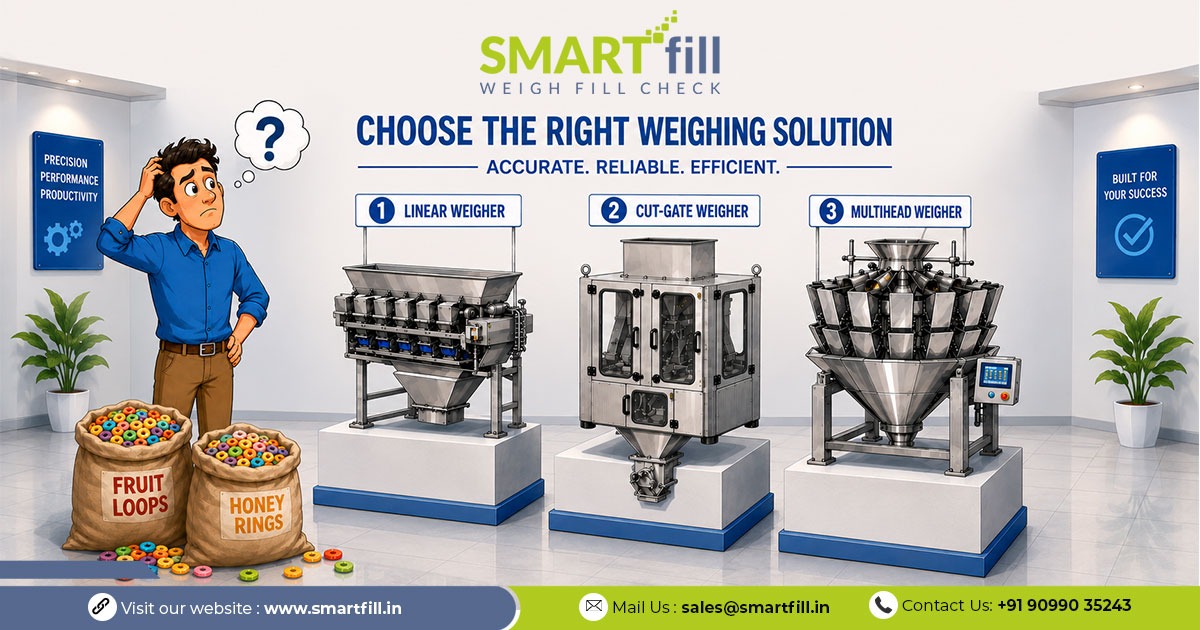
SmartFill is among the few Indian companies that design and manufacture Linear Weighers, Multihead Weighers, and Cut-Gate Weighers in-house.
Our R&D and manufacturing facility in Ahmedabad develops the mechanical architecture, controller systems, and product design that power our machines.
By maintaining control over both design and production, we are able to continuously improve our machines based on real feedback from OEM partners, brands, and plant operators.
Our approach is rooted in high empathy for the challenges faced on the production floor. Every iteration, every improvement, and every new generation of SmartFill machines is built with the goal of delivering better reliability, faster serviceability, and practical innovation for Indian manufacturing environments.
For more information or to schedule a demo:
📞 +91 90990 35243
📩 [email protected]
📍 Vatva, Ahmedabad, Gujarat